Building below4k.ai
สร้างเว็บไซต์ below4k.ai
How I used AI to build a website for my projects, articles and useful AI resources.
How I used AI to build a website for my projects, articles and useful AI resources.
- Status
- Building
- Started
- May 2026
- Last updated
- July 22, 2026
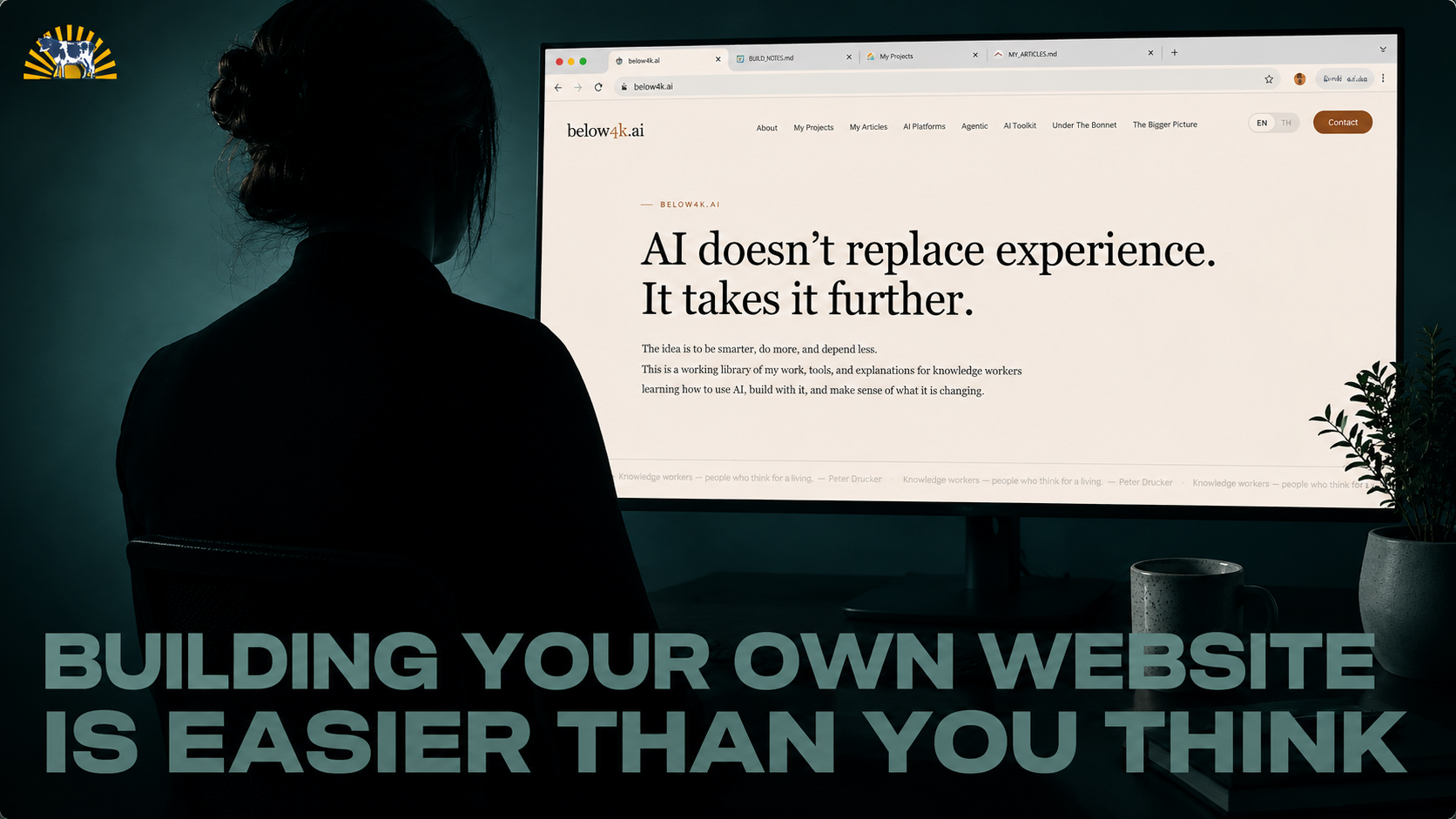
below4k.ai is a personal editorial website for keeping my AI-related projects, articles and selected resources in one place.
It is not simply a profile page. It is designed to hold work that can be updated, connected to related material and reused later in other formats.
What the website can do
- Publish original articles
I can write and publish longer pieces without changing the website code each time. - Record projects
Each project can explain what I built or explored, how I approached it and what I learned. - Connect projects and articles
A project gives the overall picture. Related articles can then explain one subject in more detail. - Organise curated resources
I can save useful Articles, Videos and Podcasts under clear subject areas instead of leaving them scattered across bookmarks and other services. - Help visitors find material
Search, filters and section navigation make it easier to move from a broad topic to a particular resource. - Support English and Thai content
Selected parts of the website can be published in both languages. Where Thai content is not yet available, the English version remains visible. - Receive enquiries
Visitors can contact me through the website. The enquiry is stored and an email notification is sent. - Reduce unnecessary third-party loading
Video and Podcast players do not load automatically. The visitor chooses whether to connect to the external service. - Update content without rebuilding the website
Most articles, page text and images can be managed through the content system rather than edited inside the application itself.
How the main content areas fit together
The website has three main content areas.
- My Projects shows what I have built or investigated.
- My Articles examines one idea or lesson in more detail.
- Curated Resources keeps useful work from other people that helped me understand a subject.
A reader can begin with a project, follow a related article and then explore outside material on the same subject.
This is more useful than keeping each piece in a separate folder or publishing it once on a social platform where it may quickly disappear from view.
What this kind of website can help with
For a knowledge worker, useful work often ends up spread across presentations, reports, project files, notes, email and social media.
A website like this can help by:
- Keeping the main version of the work in one place
The longer project account or article remains available even when shorter versions are shared elsewhere. - Giving older work a longer useful life
A report, project or idea can be updated and referred to again rather than forgotten in a folder. - Showing how different pieces relate
Projects, articles and reference material can be linked instead of presented as isolated outputs. - Providing source material for other formats
A project write-up may later support a LinkedIn post, presentation, carousel or short video script. I have not yet begun using below4k.ai this way, but the structure is there. - Showing practical work clearly
Readers can see what was built and how the thinking developed, rather than relying only on a short claim of experience.
Quick explainer
How I used ChatGPT and Codex
ChatGPT was the conversational workspace I used to think through and plan the build. Codex was the coding agent that worked with the project files and made the changes I had approved.
I decided what each part needed to do. ChatGPT helped me work through the requirements and prepare the instructions. Codex made the changes, and I inspected the result before moving forward.
The work was divided into small stages rather than handed to Codex as one large task. Some stages could be completed with relatively little supervision. Others needed close review because wording, layout and judgement mattered as much as whether the code worked.
Human in the Loop VS /goal (link to the published article) explains how I decide when AI needs close direction and when it can be given more room to work.
What I learned from the build
- A working feature may still need improvement
The Contact form can store an enquiry and send an email notification. It still needs a better response for the visitor when the enquiry is stored but the email fails. - Real content reveals problems that placeholders miss
Publishing the first article showed where spacing, headings and content blocks needed adjustment. - Technical checks are not enough
A page can work correctly and still look crowded or awkward, especially on a phone. Visual review often changed the final decision. - Small stages are easier to control
Building, checking and correcting one part at a time was more dependable than trying to complete the whole website in one pass.
Where the project stands
below4k.ai is live and continues to develop.
The main pages are available, several curated resource sections are working, articles can be published and visitors can send enquiries. I add curated Articles, Videos and Podcasts gradually when I find something worth keeping.
Full project write-ups are now being added, beginning with this account of the website itself.
Related articles
- Human in the Loop VS /goal
Why I think a human-in-the-loop approach is better for the build when you know what you want but can't define it in detail from the get-go.
- The Website Technology Stack
A simple guide to the different parts behind a website, what each one does, and how they work together.
- The Building Blocks of a Website
A practical guide to building typical websites.
below4k.ai is a personal editorial website for keeping my AI-related projects, articles and selected resources in one place.
It is not simply a profile page. It is designed to hold work that can be updated, connected to related material and reused later in other formats.
What the website can do
- Publish original articles
I can write and publish longer pieces without changing the website code each time. - Record projects
Each project can explain what I built or explored, how I approached it and what I learned. - Connect projects and articles
A project gives the overall picture. Related articles can then explain one subject in more detail. - Organise curated resources
I can save useful Articles, Videos and Podcasts under clear subject areas instead of leaving them scattered across bookmarks and other services. - Help visitors find material
Search, filters and section navigation make it easier to move from a broad topic to a particular resource. - Support English and Thai content
Selected parts of the website can be published in both languages. Where Thai content is not yet available, the English version remains visible. - Receive enquiries
Visitors can contact me through the website. The enquiry is stored and an email notification is sent. - Reduce unnecessary third-party loading
Video and Podcast players do not load automatically. The visitor chooses whether to connect to the external service. - Update content without rebuilding the website
Most articles, page text and images can be managed through the content system rather than edited inside the application itself.
How the main content areas fit together
The website has three main content areas.
- My Projects shows what I have built or investigated.
- My Articles examines one idea or lesson in more detail.
- Curated Resources keeps useful work from other people that helped me understand a subject.
A reader can begin with a project, follow a related article and then explore outside material on the same subject.
This is more useful than keeping each piece in a separate folder or publishing it once on a social platform where it may quickly disappear from view.
What this kind of website can help with
For a knowledge worker, useful work often ends up spread across presentations, reports, project files, notes, email and social media.
A website like this can help by:
- Keeping the main version of the work in one place
The longer project account or article remains available even when shorter versions are shared elsewhere. - Giving older work a longer useful life
A report, project or idea can be updated and referred to again rather than forgotten in a folder. - Showing how different pieces relate
Projects, articles and reference material can be linked instead of presented as isolated outputs. - Providing source material for other formats
A project write-up may later support a LinkedIn post, presentation, carousel or short video script. I have not yet begun using below4k.ai this way, but the structure is there. - Showing practical work clearly
Readers can see what was built and how the thinking developed, rather than relying only on a short claim of experience.
Quick explainer
How I used ChatGPT and Codex
ChatGPT was the conversational workspace I used to think through and plan the build. Codex was the coding agent that worked with the project files and made the changes I had approved.
I decided what each part needed to do. ChatGPT helped me work through the requirements and prepare the instructions. Codex made the changes, and I inspected the result before moving forward.
The work was divided into small stages rather than handed to Codex as one large task. Some stages could be completed with relatively little supervision. Others needed close review because wording, layout and judgement mattered as much as whether the code worked.
Human in the Loop VS /goal (link to the published article) explains how I decide when AI needs close direction and when it can be given more room to work.
What I learned from the build
- A working feature may still need improvement
The Contact form can store an enquiry and send an email notification. It still needs a better response for the visitor when the enquiry is stored but the email fails. - Real content reveals problems that placeholders miss
Publishing the first article showed where spacing, headings and content blocks needed adjustment. - Technical checks are not enough
A page can work correctly and still look crowded or awkward, especially on a phone. Visual review often changed the final decision. - Small stages are easier to control
Building, checking and correcting one part at a time was more dependable than trying to complete the whole website in one pass.
Where the project stands
below4k.ai is live and continues to develop.
The main pages are available, several curated resource sections are working, articles can be published and visitors can send enquiries. I add curated Articles, Videos and Podcasts gradually when I find something worth keeping.
Full project write-ups are now being added, beginning with this account of the website itself.
Related articles
- Human in the Loop VS /goal
Why I think a human-in-the-loop approach is better for the build when you know what you want but can't define it in detail from the get-go.
- The Website Technology Stack
A simple guide to the different parts behind a website, what each one does, and how they work together.
- The Building Blocks of a Website
A practical guide to building typical websites.