How Do You Know What Price to Ask for Your Property in Thailand?
ถ้าจะขายที่แต่มีข้อมูลแค่โฉนดที่ดินจะตั้งราคายังไร?
The project shows how AI can turn basic Thai land-record information into a practical property-pricing and sale-cost assessment by combining official appraisal data, local geographic discovery, market evidence and tax calculations. It provides a useful mental model for where AI and conventional software each fit: AI handles ambiguous location language, search and evidence judgement, while deterministic systems handle validation and calculations that must be repeatable. The write-up is relevant because it shows how a difficult research task became a reusable sequence of AI skills rather than a one-off prompt.
โปรเจกต์นี้แสดงให้เห็นว่า AI สามารถเปลี่ยนข้อมูลพื้นฐานจากเอกสารที่ดินของไทยให้กลายเป็นการประเมินราคาขายและค่าใช้จ่ายในการขายที่นำไปใช้ได้จริง โดยเชื่อมโยงข้อมูลราคาประเมินราชการ การทำความเข้าใจพื้นที่ หลักฐานจากตลาด และการคำนวณภาษีเข้าด้วยกัน นอกจากนี้ยังช่วยอธิบายภาพรวมว่า AI และซอฟต์แวร์แบบดั้งเดิมควรทำหน้าที่ต่างกันอย่างไร AI เหมาะกับงานที่มีความคลุมเครือ เช่น การทำความเข้าใจชื่อสถานที่ การค้นหา และการประเมินคุณภาพของหลักฐาน ขณะที่ระบบแบบกำหนดกฎชัดเจนเหมาะกับการตรวจสอบและการคำนวณที่ต้องให้ผลลัพธ์สม่ำเสมอ โปรเจกต์นี้จึงมีประโยชน์ในฐานะตัวอย่างของการเปลี่ยนงานวิจัยที่ซับซ้อนให้กลายเป็น /skills ที่นำกลับมาใช้ซ้ำได้ แทนที่จะเป็นเพียง prompt ที่ใช้ได้เพียงครั้งเดียว และไม่สามารถนำมาใช้กับสถานการณ์ที่เปลี่ยนแปลงไปได้
- Status
- Built
- Started
- May 2026
How Do You Know What Price to Ask for Your Property in Thailand?
If you want to sell a property in Thailand, how do you decide what price to ask?
The government’s official appraisal is relatively easy to obtain, but it does not necessarily reflect what buyers might pay. Understanding the market requires comparable properties, asking prices and, where available, reliable transactions.
This is difficult when you do not live near the property. You may know its province and district, but not the roads, sois, BTS or MRT stations, landmarks, or neighborhood names that sellers use.
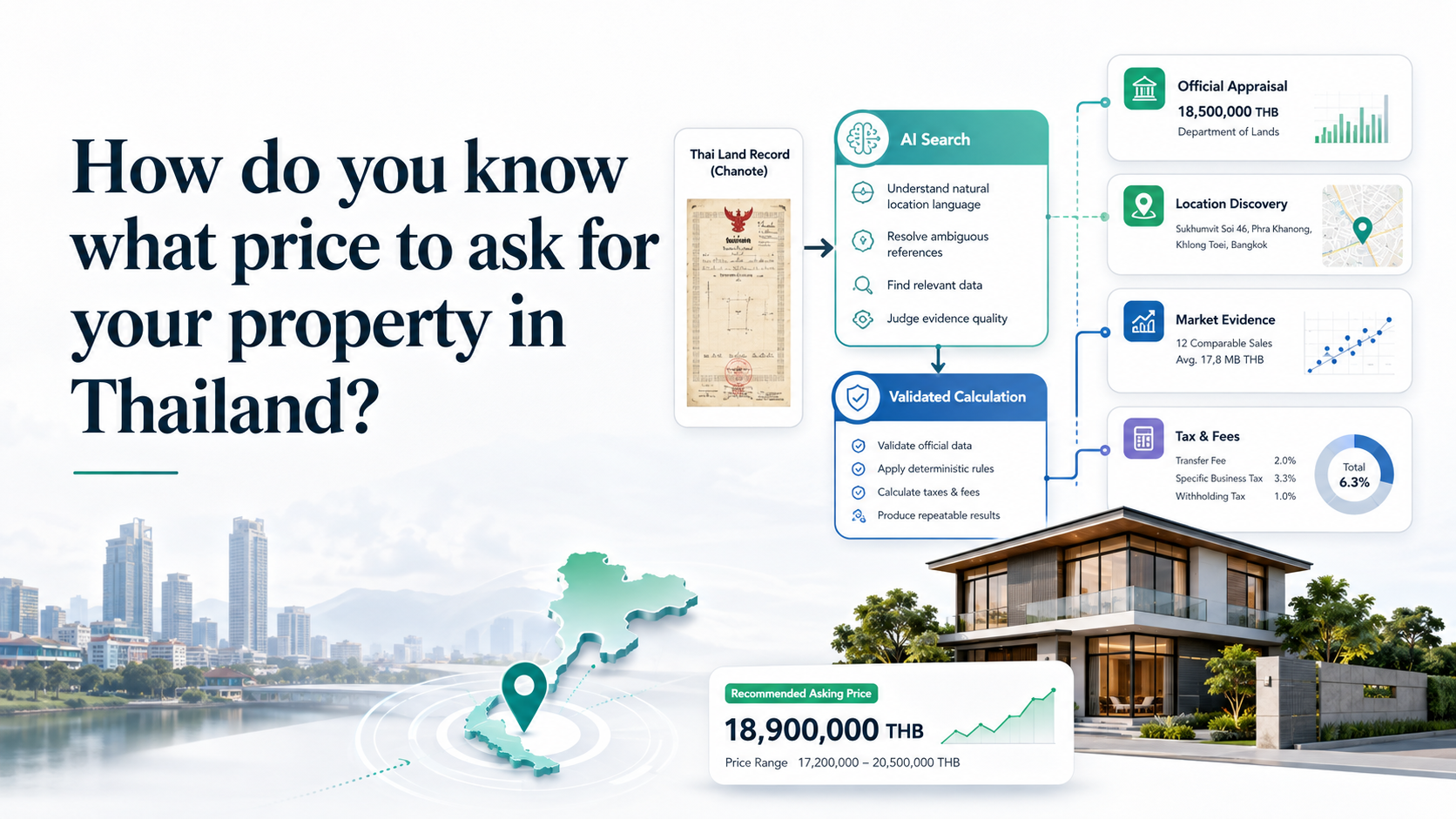
We built an AI-assisted system to bridge that gap. Starting with a land document number and basic location information, it identifies the property, learns the area, finds market evidence, develops a supported price conclusion, and estimates the taxes and government charges involved in a sale.
Starting with information you already have
For a title deed, the system asks for:
- A name you choose for the property
- The document type
- The title deed number
- The province
- The district or Bangkok administrative district
Other document types use the relevant land number, survey sheet, province, or Land Office.
A fictional input might look like this:
Property name: Sample Property
Document type: Title deed
Title deed number: [deed number]
Province: [province]
District: [district]
For the tax calculation, it later requests the proposed sale price, transfer date, seller type, acquisition method and date, and facts affecting tax treatment.
A deed and the market speak different languages
A deed describes a property through administrative information. Advertisements use a different language: a BTS station, a soi, a shopping centre, a school, or an informal neighborhood name. The same place may have several Thai and English spellings.
If you are unfamiliar with the area, you may not know what to search. Useful comparables may be online but invisible to a province-and-district search. The system must therefore translate the language of the deed into the language of the market.
From the official record to the local neighborhood
The first engine searches the Treasury Department appraisal system. It matches the document number with the administrative location and returns the confirmed identity, area, official appraisal, coordinates, map position, and source information.
The second engine examines those coordinates on platforms such as Google Maps. It identifies roads, sois, connecting routes, BTS or MRT access, and landmarks. It then develops Thai and English searches based on how buyers and sellers describe the area—not merely on its administrative district.
Searching a market that was not built for AI
The third engine searches property portals, public records, corporate documents, appraisals, and other sources. This can mean working through hundreds or potentially thousands of postings and search results.
A fixed program works well when its inputs and rules are known. Market research is less certain. The system does not know every local name, which spelling a seller will use, or whether “near” a landmark is genuinely nearby.
AI can judge probable relationships between locations, descriptions, and property characteristics. It can follow promising paths, reject weak matches, and refine its searches as it discovers new local references.
Separating evidence from online noise
Finding advertisements is not the same as finding reliable market evidence.
The same property may appear through several agents and its price may change. A portal may mark it as sold without disclosing the selling price. An asking price may reflect the seller’s hope rather than what a buyer will pay.
The system groups duplicate advertisements into one property family. It separates asking prices from transactions, contracts, appraisals, and unverified status labels. It compares useful evidence by location, size, access, shape, zoning, development potential, recency, and source quality.
The output is a supported price conclusion, asking strategy, confidence level, limitations, and source trail. If the evidence supports only a range, the system avoids false precision.
A fictional output might look like this:
Official record: Confirmed
Official appraisal: [value per square wah and total value]
Local search area: [roads, sois, BTS/MRTaccess and landmarks]
Market evidence: [number of unique comparable-property families]
Suggested asking range: [price range]
Supported market-price conclusion: [price or evidence range]
Confidence: [high, medium or low]
Estimated government charges: [itemized fees and total range]
Understanding the cost of selling
The fourth engine uses the official appraisal, proposed sale price, seller information, acquisition history, transfer date, and exemption facts to estimate the transfer fee, withholding tax, Specific Business Tax and local revenue, or stamp duty.
The owner receives an itemized estimate and total transfer-day cost. Unknown facts produce a warning or range, not a hidden assumption.
Why this was a project, not a prompt
We did not reach the final system with one instruction. Websites created for people require scrolling, pop-up handling, repeated navigation, and interpretation. They time out, change layouts, and resist automated access. Property information is also fragmented and inconsistent.
Each failure taught us something. Weak searches led to better geographic discovery. Missed evidence led to broader search methods. Duplicate listings led to property-family tracking. Unreliable conclusions led to clearer evidence classes, price gates, and validation rules.
The system therefore combines two approaches. AI handles discovery, language differences, ambiguity, and judgment. Deterministic software handles calculations and validation, where the same input must produce the same result.
Turning the work into reusable skills
The successful procedures were saved as reusable AI skills. A skill defines the required information, steps, sources, safeguards, and output. For a new property, the user supplies the inputs and invokes the relevant skill instead of explaining the process again.
The skills can run separately or in sequence: official record to geographic search, geographic search to market analysis, and appraisal and market price to the tax calculator. New lessons can be added without rebuilding the system.
A note from the builder
I first attempted this project in December 2025 using Claude’s early computer-use environment, shortly before Cowork’s public research preview. It could not complete one cycle. While entering property information on the official website, a pop-up interrupted the process and the session repeatedly timed out.
At the time, Claude Opus 4.5 was Anthropic’s leading model for agents and computer use. When I returned around five months later, Opus 4.8 offered stronger browser-agent performance and more reliable tool use. Anthropic’s announcements document the progression from Opus 4.5 to Opus 4.8.
The improvement was not only the model. The agent harness—the browser controls, tools, permissions, instructions, context management, and recovery methods around it—had also improved. In plain language, the AI was better equipped to keep its place, choose the right tool, recover from interruptions, and continue a long task.
For knowledge workers, the lesson is that AI can do more than produce text. It can explore unfamiliar environments, learn local vocabulary, navigate uncertainty, organize evidence, and work with conventional software. Useful systems still require domain knowledge, experimentation, correction, and testing.
That is how a simple starting point—a document number and basic property information—can become a practical answer to two important questions: What price should you ask, and what will the sale cost you?
How Do You Know What Price to Ask for Your Property in Thailand?
If you want to sell a property in Thailand, how do you decide what price to ask?
The government’s official appraisal is relatively easy to obtain, but it does not necessarily reflect what buyers might pay. Understanding the market requires comparable properties, asking prices and, where available, reliable transactions.
This is difficult when you do not live near the property. You may know its province and district, but not the roads, sois, BTS or MRT stations, landmarks, or neighborhood names that sellers use.
We built an AI-assisted system to bridge that gap. Starting with a land document number and basic location information, it identifies the property, learns the area, finds market evidence, develops a supported price conclusion, and estimates the taxes and government charges involved in a sale.
Starting with information you already have
For a title deed, the system asks for:
- A name you choose for the property
- The document type
- The title deed number
- The province
- The district or Bangkok administrative district
Other document types use the relevant land number, survey sheet, province, or Land Office.
A fictional input might look like this:
Property name: Sample Property
Document type: Title deed
Title deed number: [deed number]
Province: [province]
District: [district]
For the tax calculation, it later requests the proposed sale price, transfer date, seller type, acquisition method and date, and facts affecting tax treatment.
A deed and the market speak different languages
A deed describes a property through administrative information. Advertisements use a different language: a BTS station, a soi, a shopping centre, a school, or an informal neighborhood name. The same place may have several Thai and English spellings.
If you are unfamiliar with the area, you may not know what to search. Useful comparables may be online but invisible to a province-and-district search. The system must therefore translate the language of the deed into the language of the market.
From the official record to the local neighborhood
The first engine searches the Treasury Department appraisal system. It matches the document number with the administrative location and returns the confirmed identity, area, official appraisal, coordinates, map position, and source information.
The second engine examines those coordinates on platforms such as Google Maps. It identifies roads, sois, connecting routes, BTS or MRT access, and landmarks. It then develops Thai and English searches based on how buyers and sellers describe the area—not merely on its administrative district.
Searching a market that was not built for AI
The third engine searches property portals, public records, corporate documents, appraisals, and other sources. This can mean working through hundreds or potentially thousands of postings and search results.
A fixed program works well when its inputs and rules are known. Market research is less certain. The system does not know every local name, which spelling a seller will use, or whether “near” a landmark is genuinely nearby.
AI can judge probable relationships between locations, descriptions, and property characteristics. It can follow promising paths, reject weak matches, and refine its searches as it discovers new local references.
Separating evidence from online noise
Finding advertisements is not the same as finding reliable market evidence.
The same property may appear through several agents and its price may change. A portal may mark it as sold without disclosing the selling price. An asking price may reflect the seller’s hope rather than what a buyer will pay.
The system groups duplicate advertisements into one property family. It separates asking prices from transactions, contracts, appraisals, and unverified status labels. It compares useful evidence by location, size, access, shape, zoning, development potential, recency, and source quality.
The output is a supported price conclusion, asking strategy, confidence level, limitations, and source trail. If the evidence supports only a range, the system avoids false precision.
A fictional output might look like this:
Official record: Confirmed
Official appraisal: [value per square wah and total value]
Local search area: [roads, sois, BTS/MRTaccess and landmarks]
Market evidence: [number of unique comparable-property families]
Suggested asking range: [price range]
Supported market-price conclusion: [price or evidence range]
Confidence: [high, medium or low]
Estimated government charges: [itemized fees and total range]
Understanding the cost of selling
The fourth engine uses the official appraisal, proposed sale price, seller information, acquisition history, transfer date, and exemption facts to estimate the transfer fee, withholding tax, Specific Business Tax and local revenue, or stamp duty.
The owner receives an itemized estimate and total transfer-day cost. Unknown facts produce a warning or range, not a hidden assumption.
Why this was a project, not a prompt
We did not reach the final system with one instruction. Websites created for people require scrolling, pop-up handling, repeated navigation, and interpretation. They time out, change layouts, and resist automated access. Property information is also fragmented and inconsistent.
Each failure taught us something. Weak searches led to better geographic discovery. Missed evidence led to broader search methods. Duplicate listings led to property-family tracking. Unreliable conclusions led to clearer evidence classes, price gates, and validation rules.
The system therefore combines two approaches. AI handles discovery, language differences, ambiguity, and judgment. Deterministic software handles calculations and validation, where the same input must produce the same result.
Turning the work into reusable skills
The successful procedures were saved as reusable AI skills. A skill defines the required information, steps, sources, safeguards, and output. For a new property, the user supplies the inputs and invokes the relevant skill instead of explaining the process again.
The skills can run separately or in sequence: official record to geographic search, geographic search to market analysis, and appraisal and market price to the tax calculator. New lessons can be added without rebuilding the system.
A note from the builder
I first attempted this project in December 2025 using Claude’s early computer-use environment, shortly before Cowork’s public research preview. It could not complete one cycle. While entering property information on the official website, a pop-up interrupted the process and the session repeatedly timed out.
At the time, Claude Opus 4.5 was Anthropic’s leading model for agents and computer use. When I returned around five months later, Opus 4.8 offered stronger browser-agent performance and more reliable tool use. Anthropic’s announcements document the progression from Opus 4.5 to Opus 4.8.
The improvement was not only the model. The agent harness—the browser controls, tools, permissions, instructions, context management, and recovery methods around it—had also improved. In plain language, the AI was better equipped to keep its place, choose the right tool, recover from interruptions, and continue a long task.
For knowledge workers, the lesson is that AI can do more than produce text. It can explore unfamiliar environments, learn local vocabulary, navigate uncertainty, organize evidence, and work with conventional software. Useful systems still require domain knowledge, experimentation, correction, and testing.
That is how a simple starting point—a document number and basic property information—can become a practical answer to two important questions: What price should you ask, and what will the sale cost you?